About the artist
Biography
Alex Amengual (Mallorca, 1970) is a visual artist living and working between Sa Pobla and London. His work rests on a conviction carried through four decades behind the camera: that surface beauty is the least of what an image can hold, and that what endures in a work is its emotional charge. Photography remains in his practice not as an end but as an instrument — the camera transposes elements of the natural world (the body, the earth, a fishing net) onto the silkscreen, where they re-enter the work by hand.
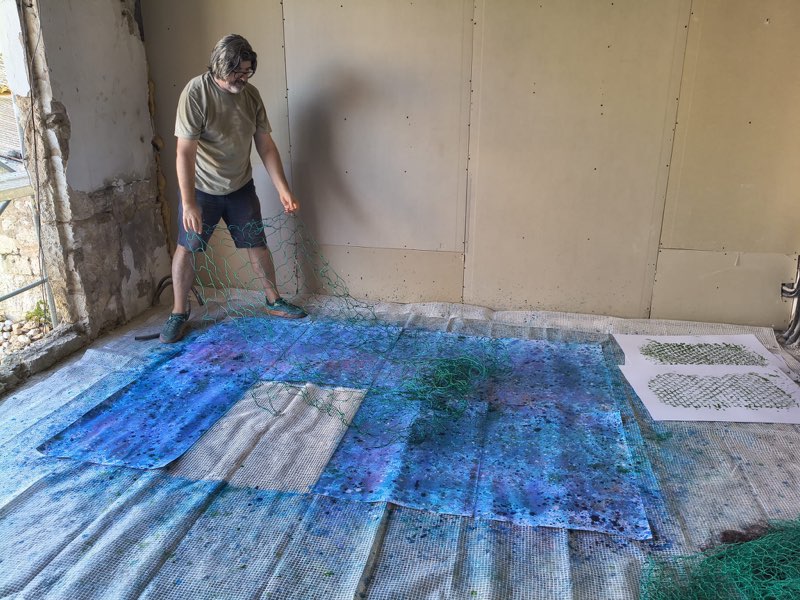
His subject is the bond between people and place, addressed through the physical matter of the place itself. In Corpus Terra (2025), he ground the agricultural earth of Sa Pobla — the town where he lives, where his son was born and his father died — into a pigment bound with a drop of his own blood, printing from it the imprint of his own body: a meditation on presence, permanence and the soil that both feeds us and receives us. A new body of work now moves him from land to coast and the sea: paintings made with acrylic diluted in seawater and worked with fishermen’s nets, over which a photographed net is screen-printed, the man-made interacting with the natural. Together the two bodies of work describe island life from an islander’s point of view — a union of the land beneath and the sea around — an inquiry that continues to widen. The son of an artist, Amengual regards this attention to what remains, of a place, of a person, of a gesture, as an inheritance.
Amengual has exhibited in Spain, the United Kingdom and the United States. Corpus Terra was first shown at Es Corro, Sa Pobla (2025), and is currently touring with the group exhibition De Meninas Va, which in 2026 has travelled to Casa de Cultura (Felanitx), Centre d’Art Sa Quartera (Inca), Sant Crist (S’Arracó) and Sala de Plens, Ajuntament d’Andratx, and opens next at Sala del Rosser, Ciutadella, Menorca, in October. The group show Reinterpretant Sant Antoni, also ongoing, has been seen at Can Soler (Sa Pobla) and Ca na Polida (Campanet). Earlier exhibitions include Centro Cultural Sa Nostra, Palma (2002), Projectile Arts, New York (2003), and galleries in Manchester and Scotland. His work is held in private collections nationally and internationally.
Artist statement
I am a visual artist from Mallorca, living and working between Sa Pobla and London. Four decades behind the camera taught me one lasting lesson: that surface beauty is the least of what an image can hold. What endures in a work — as in a face, as in a place — is its emotional charge. Everything I make begins there.
Photography remains my way of looking, but it is no longer my destination. I use the camera to transpose elements of the natural world — my own body, the earth, a fishing net — onto the silkscreen, where they return to the work by hand. The screen serves me in both of printmaking’s registers: some works exist as editions, in the photographic tradition; many others pass through it in the manner of monoprints — each impression a variant, worked and painted so that it exists only once.
My subject is the bond between people and place, and I address it through the matter of the place itself. In Corpus Terra I ground the agricultural earth of Sa Pobla — where I live, where my son was born and my father died — into a pigment bound with a drop of my own blood, and printed from it the imprint of my own body. A new body of work now moves me from land to coast and the sea: I dilute acrylic in seawater and work the paintings with fishermen’s nets from the port, then print a photographed net over each finished sea — the man-made interacting with the natural.
These two bodies of work belong to one thought. People of the land grow their food in the same soil in which they bury their dead; people of the sea draw their food from the same water that receives theirs. Sustenance and loss share a single element, and that element is what I paint with. This is island life from an islander’s point of view — the land beneath us and the sea around us — and it is an inquiry I expect to occupy me for the rest of my career.
My father was an artist, and I understand what I do as a continuation of what he began: an attention to what remains — of a place, of a person, of a gesture. I ask of the viewer only what the work asked of me: to stay long enough to stop looking and begin to feel.